Cart0
you have not items in your shopping cart.
19,00 €
LE NOZZE DI FIGARO
The Metropolitan Opera 1943 / Breisach – Pinza, Sayão, Baccaloni, Steber, Novotna
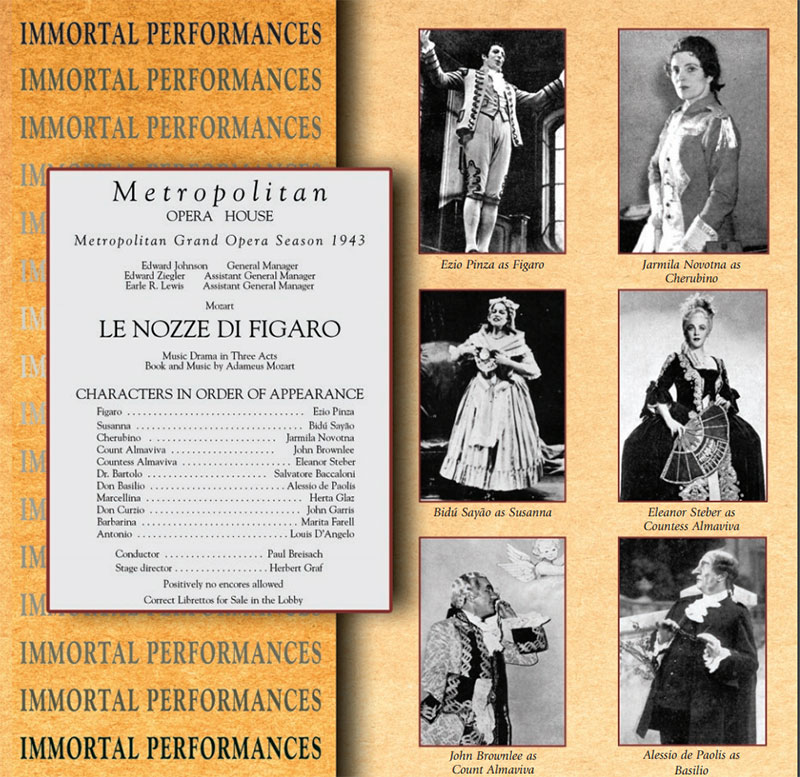
Among the seven broadcasts of Nozze between 1940 and 1950, this 1943 performance offers the best sound and the best cast: Pinza at his personable best, Sayão utterly charming – the perfect Susanna; Steber’s first portrayal as the countess and among her loveliest performances of the decade; Novotna made Cherubino her role in this era and Baccaloni was unparalleled as the jovial, scheming Dr. Bartolo. The performance, prepared by Bruno Walter, was conducted by Paul Breisach. Scintillating, good sound; this particular performance will be the one you reach for when you want to recall this Mozartean decade at the Met. Includes a booklet replete with photos of the singers on stage, notes on the performance and biographies of the singers. GHCD 2203/4/5
La Scena Musicale / the Music Scene – Summer 2004
This is another issue of historic Met broadcasts on the Guld label. It is unavailable stateside – a pity, since this is a gem. This 1943 performance was chosen for its superior sound, even though the conductor was the relative unknown Paul Breisach in place of Bruno Walter, who conducted most of the performances. With minor patching from an alternate performance with the same cast, this Nozze is an unalloyed pleasure. Top honours go to the delectable Susanna of Bidù Sayao, for her uncommon tonal beauty and vivid persona. Equally fine is the creamy-voiced, youthful Eleanor Steber (Contessa), then at the beginning of her career. Jarmila Novotna makes a lovable Cherubino. Of the men, Ezio Pinza (Figaro) may sound a bit mature, but his command of the role and strong personality are special. Salvatore Baccaloni is at his best buffo self. Only John Brownlee (Count) sounds uninvolved. Breisach conducts well but obviously not on the level of a Bruno Walter. The bonus is an enjoyable concert with Sayao and tenor Eugene Conley of arias from Manon, Faust, Le Roi d’ys, and Mefistofele. Some of the sheen has come off the Sayao voice by 1951, but the artistry remains intact. Conley sings with manly tone but dreadful Americanized French. A must for lovers of historical broadcasts.
JKS
International Record Review – April 02
Mozart Le nozze cli Figaroa.Following the 1943 spring tour, the Metropolitan Opera’s Figaro returned to New York for additional performances, including a broadcast. Under conductor Paul Breisach, the Overture is performed authoritatively, but later, stage and pit are not always in sync, with portions of the more heavily populated scenes occasionally turning raucous or frantic. Breisach does frequently get things just right, particularly in more restrained moments (for example, the ideally buoyant tempo for the Letter Duet and the nicely airy orchestral underpinning for Susanna’s Act 4 aria). Ultimately, nothing seriously hinders the teamwork achieved in earlier performances under Ettore Panizza and Bruno Walter.
Heading the cast are Pinza and Sayão, whose irrepressible personalities burst through one’s speakers. The bass is this performance’s lynchpin – a Figaro of almost startlingly vivid vocal presence, every phrase uttered with extraordinary spontaneity, the recitatives delivered as genuine ‘sung speech’. Only the high Fs of the opening scene find him wanting; otherwise the portrayal is incomparable, culminating in a knowing, dangerous, memorably sarcastic account of the Act 4 soliloquy. Sayão is very much the Latin spitfire, failing to convince only in the excessive coyness of her Act 3 dialogue with the Count. Her ‘Deh, vieni’ is thoughtfully conceived and exquisitely phrased.
Although not in consistently mellifluous voice, Novotna makes a sensitive and charming Cherubino, partnered by Farell’s unusually full-voiced Barbarina. Glaz is a blessedly unexaggerated Marcellina, supporting Baccaloni’s inimitable, gloriously pompous Bartolo. Both comprimario tenors contribute strongly, as does d’Angelo’s Antonio.
As for the Almavivas, he is a disappointment, she a triumph. While not exactly letting the side down, Brownlee sings rather stiffly, with little beauty or variety. Steber, however, ravishes the ear and, at just 27, displays a magnificent technique. Even in the most agitated moments of Act 2, her tone retains its glow. Vocally speaking, she compares favourably with any Countess on disc. Her Italian, like Brownlee’s, is hardly authentic, and the characterization could be more probing (Steber would interpret in far greater detail as the Met’s Fiordiligi and Donna Anna in the 1950s), but the required vulnerability and dignity are already evident.
The audience applauds at the slightest provocation. The recorded sound varies wildly, but even at its most muffled and noisy, it does not seriously compromise one’s enjoyment. No libretto, just a synopsis, an effusive essay about the performance and biographies of Pinza, Sayão, Steber and Novotna (no Brownlee, which is disgraceful – he is left off the CD cover as well). All in all, not a Figaro for anyone seeking a single performance, but invaluable as a historical supplement and vocally almost uniformly superior to the legendary Glyndebourne recording of 1934 (sacrilegious though it may be to say so!).
Completing the third disc are 1951 performances by Sayão and tenor Eugene Conley, sabotaged by a stodgy conductor. The soprano’s Marguerite, surprisingly, is less effective than her Margherita (a riveting ‘L’altra notte’, lacking only an effective trill). Sayão’s delectable Manon inspires her partner in their duet. Conley is handicapped by very American French, but we would welcome his secure, manly sound today.
Roger Pines
Classical Music on the Web – January 2002
This is a wonderful performance of Figaro taken live from the Met during the Second World War, the cast as good as anyone could surely wish for, though I do have one reservation. Guild Music has an association with Immortal Performances which has an archive of first-generation historic broadcasts from the 1930s and 1940s. This initial release (a complete 1937 Siegfried, excerpts from a 1928 Boris Godunov with Chaliapin, and all of Act 2 of Parsifal from 1938 are the other mouth-watering offerings) sets a standard hard to beat. All the discs are transfers from the original transcription discs master tapes, and the complete Toscanini concerts are also planned.
Regrettably Bruno Walter’s performances of this production earlier in 1943 were not up to transferable standard but one is assured that Paul Breisach takes over with very little change. His tempi occasionally hurry but lapses in ensemble are rare, and when they are, it is either the drama which has caused it, or distant upstage singing. Act Four has a rushed conclusion which almost leaves the timpanist behind but he does catch up. The audience is fully involved, laughs when you expect them to (Cherubino, the Count and THAT chair, the revelation to Susanna of Figaro’s parentage in the Sextet in Act 3, the slaps he gets in Acts 3 and 4, and Antonio’s denial that he saw a horse jump down from the window in Act 2), showing that they knew their Italian, and their opera, without the aid of surtitles. The only irritant is the applause which greets each new character on his or her first appearance (and therefore covers Mozart’s glorious music), though is it critical discernment which makes them deny this accolade to John Brownlee as Count Almaviva? If so I must agree with them. Despite his Glyndebourne pedigree nine years before, his wooden delivery comes not within a mile of the combined artistry of Ezio Pinza or Salvatore Baccaloni – it’s all terribly British and disappointingly dull until his Act 3 aria where at last, and not a moment too late, he begins to unbutton vocally and respond to the vocal glories of his colleagues which surround him. Pinza is in glorious voice, dynamic and powerfully dramatic when his ire is aroused but his voice never forces nor loses its natural beauty, and one can see Baccaloni as one listens to his vivid and personable portrayal of Doctor Bartolo.
The women are simply glorious without exception, wonderfully moving singing by the Bruno Walter protégée Steber (this was her broadcast debut), a bright and bubbly performance by Sayão as Susanna. When the two of them sing the Letter Duet one could wish for nothing more on this mortal coil, it really is that ravishing a blend. There’s an ardent Cherubino from the stunning Novotna, and the usual antics from Marcellina and Barbarina, Glaz and Farell respectively.
The orchestra is excellent, the continuo playing regrettably on a piano (but that must be expected from those days), with the player occasionally failing to keep the action moving after arias or ensembles thanks to persistent audience applause, and one senses his frustration. On the whole the sound is good (a few dips here and there), some spots had to have inserts from a different broadcast (but with the same cast of course) when the original was unacceptable, there’s noise here and there apart from stage sounds and footfalls, and the prompter’s audibility is an irritant – one wonders that he would be needed with such a cast, but again that’s a small price to pay for the vocal glories of this set, anyway but it all adds to the flavour of the performance and to the sense of occasion.
The filler is an hour of a post-war broadcast concert, the spoken commentary between numbers retained despite its rather black-and-white film stilted delivery, but it gives a chance to hear the Brazilian Sayão again in more pyrotechnical music (eight years after Figaro, the voice has more body the lower range more textual colour), while the American tenor Eugene Conley is very impressive in his Lalo and Massenet arias. The final track is an eloquent and raptuorous account by both singers (in an excellent blend) of the duet which concludes the first act of Manon, excellent that is apart from Conley’s execrable spoken French.
I cannot recommend this Figaro set highly enough.
Christopher Fifield
Wonderful performance of Figaro taken live from the Met during the Second World War, the cast as good as anyone could surely wish for. An initial release with some mouth-watering offerings to come from Guild.
Robert Farr has also listened to this recording
Guild Music’s “Immortal Performances”, a series of operas and orchestral works derived from broadcasts, was launched in January 2002. The sources come via the Immortal Performances Recorded Music Society and Richard Canniel who have had access to NBC (American) broadcast transcriptions and preservations made for singers, from the 1930s and 1940s. These first generation tapes, originally made in the late 1940s, have been subject to restorative techniques aimed specifically at preserving the overtones of the voice and instruments, as well as the original acoustic; no electronic reverberation has been added. Where, as was often the case with NBC, more than one performance of an opera was broadcast in a season, the choice has been made on the basis of the best sounding performance available. On these facts it is claimed that this series represents “The Finest in Broadcast Recordings”. Many will also be heartened to see the name of Keith Hardwick as “Series Consultant. Certainly the NBC opera broadcasts from the Met, which continue to this day, have casts and conductors which read like a roll-call of the greatest, just as they often still do. If the series’ aims are realised by the discs issued, it will be a veritable treasure-trove of pleasure for collectors. It should, perhaps, be pointed out more clearly that an unusual degree of artistic licence has been used in these transfers to CD in that where masters were found to be in poor condition, insertions have been made from other performances, usually, but not always, involving the same cast and conductor. While the reasons are laudable, some purists may find this unacceptable. It will be incumbent on reviewers to point out these insertions when present. The 1942-43 season at the Met, was memorable for the series of performances of Figaro under the baton of Bruno Walter and which are the basis of this set. Regrettably, Richard Caniell tells us in his note, the broadcast under Walter is far inferior in sound to this post-tour performance under Breisach, who provides a well-paced and pointed contribution with good control of ensemble. Walter, contentiously, had chosen the young Eleanor Steber as the Countess. Born 1916, she had made her Met debut barely two years before as Sophie in Rosenkavalier, and the management had reservations. In no way can her tone be described as refulgent or creamy as Te Kanawa’s was when she was launched in the same part at Covent Garden in 1971. Steber’s is a girlish Countess with a light silvery tone. Her Porgi Amor (CD1 tr19) lacks nothing in expression. There is no vocal confusion with the spunky fuller toned Susanna of Bidu Sayao, who in her 16 seasons at the Met, sang 12 roles including Rosina, Violetta (much admired ), Adina and Gilda. Here, she holds a lovely line, bringing great nuance and expression to her singing; she sparkles throughout. Her Deh vieni (CD3 tr6) shows her strengths to perfection. The third major female singing role, that of the trousers role of Cherubino, is taken by Jarmila Novotna. Born in Prague in 1907 she had a considerable career in Europe before arriving at the Met in 1940. (She had sung Adina with Schipa, Gilda with Lauri-Volpi, and Butterfly with Tauber with whom she sang the world premiere of Lehár’s Giuditta – quite a list!). In sixteen seasons with the Company she sang 205 performances of 14 roles. Although later she sang Orlofsky and Octavian she did not dwell in the mezzo fach. A woman of grace and beauty she must have made a great impression as Cherubino with vocal heft and colourful tone. The men in the cast are equally distinguished. The eponymous hero is sung by the great Ezio Pinza. Born 1892, he spent 22 seasons at the Met.(1926-48), before going over to musicals including South Pacific’s “Some Enchanted Evening”, giving. 878 performances of 52 roles in 48 operas. As Figaro he gives a firm toned, vocally secure performance with a wide range of expression; nuances with his native language are a listening pleasure, even if his tone and phrasing are not as mellifluous as Taddei’s for Giulini or Siepi’s for Kleiber; both compatriots. However, Pinza’s tonal bite (allied, could we but see it, to his renowned histrionic ability), make this a formidable portrayal. The Count of John Brownlee, well known as Don Giovanni at pre-war Glyndebourne, and who sang 20 seasons at the Met. (1937-57), is no match for Pinza as a vocal actor, but his firm full-toned singing has bite; plenty of electricity sparks between this master and his servant!
Of the other singers, the most distinguished by reputation and performance is the Bartolo of Salvatore Baccaloni. Much admired in buffo roles, one senses that the audience were feeding from every vocal nuance and facial expression. He scarcely finishes his aria before applause breaks in.
The usual theatre cuts common at the time are applied. This allows 37 minutes, including commentary, of extracts from a Standard Hour Concert given by Bidu Sayao and tenor Eugene Conley in San Francisco in September 1951. Sayao’s is the voice to listen to, particularly the two extracts from Manon.
Back to Figaro. It is a sparkling performance, very well sung and conducted and, sound-wise, easy to listen to. The voices are heard to better effect than the more recessed orchestra. Yes, there are some clicks and surface noise from time to time. Those used to listening to live, or studio, recordings from this period will find little to object to and much to enjoy. However, the matter of applause is more contentious. Then, as now, Met. audiences give regular vent to applause, not only at the end of arias and acts, but often on the lifting of a curtain or the entrance of a favourite singer. This has an inevitable effect on the frisson of a live performance.
The booklet provides track listings, photographs and biographical details of the singers, and detailed comments on the performances and the selections made. Interpolations from a different broadcast, with the same cast, that “amount to 5 minutes in Act. 1, some 6 minutes in Act. 2, two instances of three minutes in Act 3 and a very short patch in Act 4” are noted.
Robert J Farr
| Weight | 1 kg |
|---|---|
| Label | GUILD Historical |
| Artists | MOZART |
Allgemeine Geschäftsbedingungen
Allgemeine Geschäftsbedingungen (nachfolgend AGB genannt) der BesteMusik und dem www.cleartone.de , im folgenden BesteMusik und www.cleartone.de genannt.
(Stand: Mai 2017)
Die nachstehenden Geschäftsbedingungen gelten für alle elektronisch, telefonisch, persönlich, per Brief oder E-Mail an BesteMusik übermittelten Bestellungen durch Kunden und werden mit jeder Bestellung von den Kunden anerkannt.
Endverbraucher im Sinne dieser Geschäftsbedingungen sind natürliche Personen, mit denen in Geschäftsbeziehungen getreten wird, ohne dass diesen eine gewerbliche, selbständige oder freiberufliche Tätigkeit zugerechnet werden kann. BesteMusik bietet keine Produkte zum Kauf durch Minderjährige an.
Kunden im Sinne dieser Geschäftsbedingungen sind Endverbraucher.
Die Geschäftsbedingungen im BesteMusik Onlineshop gelten für alle Käufe bei BesteMusik music shop, die von Endverbraucher getätigt werden. Endverbraucher im Sinne dieser Geschäftsbedingungen sind natürliche Personen, mit denen in Geschäftsbeziehungen getreten wird, ohne dass diesen eine gewerbliche, selbständige oder freiberufliche Tätigkeit zugerechnet werden kann.
Unternehmer werden gebeten, Bestellungen über andere Kommunikationswege wie Telefon oder E-Mail zu tätigen.
Abweichende, entgegenstehende oder ergänzende AGB werden nicht Vertragsbestandteil, es sei denn, ihre Geltung wird ausdrücklich schriftlich vereinbart. Dem formularmäßigen Hinweis auf Geschäftsbedingungen des Kunden wird widersprochen.
2.1 Vertragsschluss für Endverbraucher im BesteMusik music shop
Mit der Präsentation unserer Waren und der Einräumung der Möglichkeit zur Bestellung ist noch kein verbindliches Angebot unsererseits verbunden. Erst Ihre Bestellung stellt ein Angebot an uns zum Abschluss eines Kaufvertrages dar. Wenn sie eine Bestellung bei uns aufgeben, werden Sie von unserem System insgesamt zweimal aufgefordert Ihre Bestelldaten auf ihre Richtigkeit hin zu prüfen. Nach Beendigung des Bestellvorgangs im BesteMusik music shop, senden wir Ihnen an die von Ihnen angegebene E-Mail-Adresse eine E-Mail mit der Ihrer Bestellung im www.cleartone.de zu, in der wir den Eingang Ihrer Bestellung bestätigen, deren Einzelheiten aufführen (Bestellbestätigung) sowie den Rechnungsbetrag, die Rechnung- / Zahlungsart, Anschrift und Versandkosten aufführen. Mit dieser E-Mail ist ein rechtmäßiger Kaufvertrag zustande gekommen.
3.1 Preise und Versandkosten für Endverbraucher im BesteMusik music shop
Die ausgezeichneten Preise im www.cleartone.de sind Endpreise inkl. der jeweils gültigen, gesetzlichen Mehrwertsteuer. Es gilt der Betrag der jeweils zum Zeitpunkt der Bestellung ausgewiesen ist. Hinzu kommen Versandkosten, die von der Versandart, Bestellwert sowie Hinsendeland abhängig ist.
Die regelmäßigen Standardkosten der Rücksendung, die im Falle einer Rückgabe der Ware durch Sie in Ausübung Ihres Widerrufsrecht entstehen, trägt der Endverbraucher die unmittelbaren Kosten der Rücksendung der Ware. Bei Ausübung Ihres Widerrufsrechts erstatten wir Ihnen auch die Versandkosten (Hinsendekosten) zurück.
4.1 Zahlung für Endverbraucher im BesteMusik music shop
Die gelieferte Ware verbleibt bis zur vollständigen Zahlung unser Eigentum.
Die Bezahlung erfolgt bei Lieferung innerhalb der Bundesrepublik Deutschland entweder per Nachnahme (zzgl. Nachnahmegebühren), per Vorkasse.
Www.cleartone.de weist ausdrücklich darauf hin, dass die jeweilige Spedition zur Bezahlung von Nachnahmesendungen nur Bargeld akzeptiert.
Die Bezahlung bei Lieferung im europäischen Ausland erfolgt entweder per Vorkasse.
5.1 Zahlungsverzug bei Endverbraucher im BesteMusik music shop
Kommen Sie in Zahlungsverzug, so ist www.cleartone.de berechtigt, Verzugszinsen in Höhe von 6 Prozentpunkten über dem von der Deutschen Bundesbank für den Zeitpunkt der Bestellung bekannt gegebenen Basiszinssatz p.a. zu fordern. Falls Www.cleartone.de ein höherer Verzugsschaden nachweisbar entstanden ist, ist Www.cleartone.de berechtigt, diesen geltend zu machen.
Ein Recht zur Aufrechnung steht dem Kunden nur zu, wenn seine Gegenansprüche rechtskräftig festgestellt oder von BesteMusik oder Www.cleartone.de unbestritten sind. Außerdem ist er zur Ausübung eines Zurückbehaltungsrechts nur insoweit befugt, als sein Gegenanspruch auf dem gleichen Vertragsverhältnis beruht.
7.1 Lieferung und Transport für den Endverbraucher im BesteMusik music shop
7.1.1
Die Lieferung erfolgt an die vom Kunden angegebene Lieferanschrift.
7.1.2
Die bestellten Waren werden im Rahmen der Lieferbarkeit des Artikels durch Www.cleartone.de nach Geldeingang auf das angegebene Konto von Www.cleartone.de versendet. Bei Nachnahmesendungen werden die bestellten Waren im Rahmen der Lieferbarkeit des Artikels durch www.cleartone.de gleich versendet. Die Zahlung erfolgt an den Spediteur. Wir weisen darauf hin, dass die Spedition nur Barzahlungen akzeptiert.
7.1.3
Es gelten die Lieferkosten, die zum Zeitpunkt der Bestellung des Kunden bei dem jeweiligen Artikel auf der Internetseite angegeben sind. Ab einem Bestellwert von über 50 EUR innerhalb Deutschlands und Österreich übernimmt www.cleartone.de die Versandkosten.
7.1.4
Bei einem Warenwert von weniger als 510,00 € wird die Ware innerhalb Deutschlands mit UPS versendet. Innerhalb und ausserhalb der europäischen Gemeinschaft (ausgenommen Deutschland) wird die Ware bis Warenwert 510,00 € entweder per FedEx, Hermes oder UPS versendet.
Ab einem Warenwert von über 510,00 € erfolgt der Versand der Ware innerhalb Deutschlands mit UPS und innerhalb und außerhalb der europäischen Gemeinschaft entweder mit FedEx, Hermes oder UPS. Eventuell anfallende Zuschläge für Zoll und Sondergebiete übernimmt ausschließlich der Endverbraucher.
7.1.5
Sendungen ab 40,00 kg und Sperrgut (Pakete mit einem größeren Volumen als 1 qm) werden in der Regel nicht mit FedEx, Hermes oder UPS, sondern per Spedition geliefert. Www.cleartone.de weist ausdrücklich darauf hin, dass diese Ware nicht ins Haus getragen wird.
7.1.6
Alle Sendungen werden grundsätzlich bis 500,00 € versichert. Auf schriftlichen Wunsch sichern wir die Ware gegen Berechnung der entstehenden Mehrkosten auch in der von Ihnen gewünschten Höhe ab.
Sollten gelieferte Waren offensichtliche Transportschäden aufweisen, wird der Endverbraucher gebeten, solche Fehler möglichst umgehend gegenüber BesteMusik zu reklamieren. Die Versäumung dieser Rüge hat allerdings für Ihre gesetzlichen Ansprüche und deren Durchsetzung, insbesondere Ihre Gewährleistungsrechte keinerlei Konsequenzen. Sie helfen uns aber, unsere eigenen Ansprüche gegenüber dem Frachtführer bzw. der Transportversicherung geltend machen zu können.
7.1.7
Soweit eine Lieferung an den Kunden nicht möglich ist, weil die gelieferte Ware nicht durch die Eingangstür, Haustür oder den Treppenaufgang des Kunden passt oder weil der Kunde nicht unter der von ihm angegebenen Lieferadresse angetroffen wird, obwohl der Lieferzeitpunkt dem Kunden mit angemessener Frist angekündigt wurde, trägt der Kunde die Kosten für die erfolglose Anlieferung.
7.1.8
Zu Ihrer Sicherheit erfolgt der Versand grundsätzlich in Originalverpackung.
7.1.9
Macht höherer Gewalt (Naturkatastrophen, Krieg, Bürgerkrieg, Terroranschlag) die Lieferung oder eine sonstige Leistung dauerhaft unmöglich, ist eine Leistungspflicht von www.cleartone.de ausgeschlossen. Bereits gezahlte Beträge werden von www.cleartone.de zurück erstattet.
7.1.10
www.cleartone.de kann außerdem die Leistung verweigern, soweit diese einen Aufwand erfordert, der unter Beachtung des Inhalts des Kaufvertrages und der Gebote von Treu und Glauben in einem groben Missverhältnis zu dem Interesse des Kunden an der Erfüllung des Kaufvertrages steht. Bereits gezahlte Beträge werden von www.cleartone.de zurück erstattet.
Siehe Widerrufsbelehrung
Alle gelieferten Waren bleiben bis zur vollständigen Bezahlung im Eigentum von BesteMusik.
Das Vorbehaltseigentum erstreckt sich auch auf verarbeitete Gegenstände und im Falle der Weiterveräußerung auf die Kaufpreisforderung (verlängerter Eigentumsvorbehalt).
Solange dieser Eigentumsvorbehalt besteht, darf der Endverbraucher die Ware weder weiterveräußern noch über die Ware verfügen; insbesondere darf der Kunde Dritten vertraglich keine Nutzung an der Ware einräumen.
10.1 Gewährleistung und Haftung für Endverbraucher im BesteMusik music shop
10.1.1
Die Gewährleistungsansprüche des Endverbrauchers beschränken sich zunächst auf das Recht zur Nachbesserung oder Ersatzlieferung, wobei die Wahl des Endverbrauchers durch www.cleartone.de abgelehnt werden kann, wenn sie nur mit unverhältnismäßigen Kosten möglich ist. Die Nachbesserung gilt mit dem erfolglosen zweiten Versuch als fehlgeschlagen, wenn sich nicht insbesondere aus der Art der Sache oder des Mangels oder den sonstigen Umständen etwas anderes ergibt. Ist die Nacherfüllung fehlgeschlagen oder hat Www.cleartone.de die Nacherfüllung verweigert oder auf eine vom Endverbraucher gesetzte angemessene Frist nicht reagiert, so ist der Endverbraucher zur Herabsetzung der Vergütung oder zum Rücktritt vom Vertrag berechtigt. Sollte jedoch der angegebene Fehler nicht feststellbar sein, so müssen wir leider die entstandenen Prüfkosten in voller Höhe berechnen, da diese nicht durch die Garantie abgedeckt werden. Des weiteren wird der Endverbraucher darauf hingewiesen, dass kein Gewährleistungsfall vorliegt, wenn das Produkt bei Gefahrübergang die vereinbarte Beschaffenheit hatte. Ein Gewährleistungsfall liegt insbesondere in folgenden Fällen nicht vor:
10.1.2
Die Gewährleistungszeiten sind abhängig vom jeweiligen Produkt.
Die Mindestgewährleistungszeit beträgt 24 Monate.
Bei Geräten mit einer hauseigenen Gewährleistung (Geräte die direkt über www.cleartone.de käuflich erworben sind) wenden Sie sich im Servicefall innerhalb der Gewährleistungszeit bitte grundsätzlich nur an uns, da ausschließlich unser Haus die Gewährleistung für Sie erbringen muss. Die Gewährleistungszeiten beträgt 24 Monate.
Unsere Gewährleistung schließt alle Kosten (Material und Arbeitszeit) ein, welche zum Instandsetzten des Gerätes nötig sind, nicht jedoch die Versandkosten.
Bei Gewährleistungsreparaturen zahlt der Käufer die Versandkosten für den Hintransport, wir übernehmen die Versandkosten für den Rücktransport.
Der mangelhafte Liefergegenstand ist www.cleartone.de zur Besichtigung bereitzuhalten. Bei Verstoß gegen die vorstehenden Verpflichtungen sind Gewährleistungsansprüche ausgeschlossen. Mängelansprüche bei Gebrauchtwaren (B-Ware) bestehen nicht.
Um die volle BesteMusik Garantie in Anspruch nehmen zu können, senden Sie uns bitte die beigelegte Garantiekarte innerhalb von zwei Wochen korrekt und vollständig ausgefüllt zu. Sie erhalten eine Garantiebestätigung per E-Mail (sofern Sie uns Ihre E-Mail Adresse mitgeteilt haben). Nur wenn die Rückware in der Originalverpackung zurück gesandt wird erweitert* sich die Garantiezeit (*je nach Produkt). Sonst kann nur die gesetzliche Gewährleistung von 24 Monaten berücksichtigt werden. Nachträglich registrierte Produkte erhalten keine Garantieverlängerung mehr.
Während der Garantieperiode brauchen Sie keine Reparaturkosten für Ihr BesteMusik Produkt zu bezahlen. Weitere Ansprüche über die Reparaturkosten hinaus sind jedoch ausgeschlossen. Sollte der Defekt am Produkt durch unsachgemäßen Gebrauch, Fremdeinwirkung oder nicht-autorisierte Modifikationen entstanden sein, sind die Reparaturkosten nicht von der Garantie abgedeckt. Die Garantieperiode beginnt mit Erstverkauf des Produktes durch BesteMusik music shop. Als Nachweis dient der Kaufbeleg, der vorgelegt werden muss. Geben Sie Ihr defektes Produkt in der Originalverpackung mitsamt Innenverpackung ab.
Www.cleartone.de und BesteMusik schließt die Haftung für Schäden, die durch einfache Fahrlässigkeit verursacht worden sind, aus, sofern diese keine vertragswesentlichen Pflichten, Schäden aus der Verletzung des Lebens, des Körpers oder der Gesundheit oder Garantien betreffen oder Ansprüche nach dem Produkthaftungsgesetz berührt sind.
Bei der Verletzung wesentlicher Vertragspflichten ist die Haftung in Fällen einfacher Fahrlässigkeit auf die Schäden, die in typischer Weise mit dem Vertrag verbunden und vorhersehbar sind, beschränkt. Schadensersatzansprüche aus Verzug oder nachgewiesene Ansprüche auf Aufwendungsersatz gemäß § 284 BGB sind auf 10% des Kaufpreises beschränkt, soweit www.cleartone.de oder BesteMusik nicht vorsätzlich oder grob fahrlässig gehandelt hat.
Alle persönlichen Daten werden selbstverständlich vertraulich behandelt.
Listenmäßige Adressdaten nutzt und übermittelt www.cleartone.de und BesteMusik ggf. für werbliche Ansprachen seiner vertrauenswürdigen Partnerunternehmen. Selbstverständlich kann der Endverbraucher und Unternehmer der Weitergabe seiner Daten für Werbezwecke jederzeit widersprechen, indem er formlos z.B. Einspruch per Post (Stichwort: Datenschutz, BesteMusik, Loecknitzer Str. 17, 17321 Bergholz) oder per E-Mail (ct@cleartone.de) erhebt.
Durch die Bestellung erklärt sich der Kunde mit der Speicherung seiner Daten einverstanden. Er ist jederzeit berechtigt, seine Daten einzusehen und ggf. Angaben verändern bzw. löschen zu lassen. Näher siehe Datenschutz.
Siehe Datenschutz
Dieser Vertrag unterliegt ausschließlich dem Recht der Bundesrepublik Deutschland unter ausdrücklichem Ausschluss des UN-Kaufrechts.
Sofern der Kunde Endverbraucher ist, ist Neubrandenburg; Www.cleartone.de ist jedoch berechtigt, den Endverbraucher auch an seinem Wohnsitzgericht zu verklagen. Erfüllungsort für Unternehmer ist Neubrandenburg.
Für Endverbraucher und Unternehmer aus anderen EU-Mitgliedsstaaten ist Gerichtsstand und Erfüllungsort ausschließlich Neubrandenburg.
Sind diese AGB ganz oder teilweise nicht Vertragsbestandteil geworden oder unwirksam, so bleibt der Vertrag im Übrigen wirksam. Soweit die Bestimmungen nicht Vertragsbestandteil geworden oder unwirksam sind, richtet sich der Inhalt des Vertrags nach den gesetzlichen Vorschriften. Der Vertrag ist nur dann unwirksam, wenn das Festhalten an ihm auch unter Berücksichtigung der nach den gesetzlichen Vorschriften vorzunehmenden Änderungen eine unzumutbare Härte für eine Vertragspartei darstellen würde.
Siehe Impressum
© 2017 BesteMusik, BesteMusik music shop
There are no reviews yet.
 Lindemann - Limetree Network II
1.119,00 €
Lindemann - Limetree Network II
1.119,00 €
 Clearaudio FRIENDS OF CARLOTTA


Reviews